
A Motorized / Electromagnetic Sieve Shaker is a laboratory testing instrument designed for particle size analysis, granulometric analysis, and size distribution of solid materials. It operates as a vibrating test system that ensures accurate and repeatable separation of particles based on size.
This equipment is widely used across multiple industries due to its high versatility, efficiency, and reliability in separating granular materials. Sieves with different mesh sizes are stacked within the shaker to retain particles of varying dimensions. Multiple sieves can be used simultaneously, allowing fine sediments to pass through and be collected at the bottom for precise analysis.
ELECTROMAGNETIC SIEVE SHAKER
- The electromagnetic sieve shaker utilizes round sieves of 8”, 5”, or 3” diameter for granulometric and particle size analysis. It features manual vibration adjustment via a selector switch, an integrated timer, automatic shut-off, programmable vibration settings, and operates on 110/220 V power supply.
- The shaker can accommodate up to six sieves of 2-inch height or twelve sieves of 1-inch height. Granulometric and particle size analysis is a critical process in both laboratory and industrial environments, as it ensures accuracy, efficiency, and reliability in analytical operations.
- Electromagnetic sieve shakers play a vital role in strict quality control procedures, soil analysis, and material evaluation. Their dependable performance ensures safe operation and consistent results, contributing to customer confidence and operational efficiency. Selecting reliable sieve shaker suppliers is essential for effective laboratory management.
Motorized Sieve Shaker – Detailed Working Principle
- A motorized sieve shaker is a precision laboratory instrument designed to separate and classify particulate materials based on particle size distribution (granulometry). It operates using standardized round test sieves and controlled mechanical motion to ensure accurate, repeatable, and efficient particle separation.
- Sieve Stack Arrangement:The process begins by assembling a stack of test sieves with progressively decreasing mesh sizes. The sieve with the largest mesh opening is placed at the top, followed by sieves with finer mesh sizes arranged in descending order. A collection pan is positioned at the bottom of the stack to capture particles smaller than the finest sieve aperture. This structured arrangement ensures systematic separation of particles according to size.
- Sample Loading:The material sample to be analyzed is placed on the topmost sieve. Proper sample quantity is essential to avoid overloading, which can affect sieving efficiency and accuracy. Once the sample is loaded, the sieve stack is securely clamped to prevent movement during operation.
- Motorized Vibration and Motion:Upon activation, the internal electric motor generates controlled mechanical vibrations. These vibrations are transmitted uniformly through the sieve stack, causing the particles to move and redistribute across the sieve surfaces. Depending on the design, the motion may include vertical, horizontal, or combined circular and tapping movements.
- Particle Separation Mechanism:As the sieve shaker operates, particles smaller than the mesh openings pass through the sieve due to gravity and vibration, while larger particles are retained on the sieve surface. This progressive filtration continues through each sieve layer, resulting in effective size-based separation.
- Screening Duration and Control:The sieving process runs for a predefined time, which can be adjusted based on material type, particle size range, and testing standards. Consistent sieving time ensures reproducibility of results and compliance with laboratory testing protocols.
- Completion and Analysis:After the set duration, the shaker stops automatically. Each sieve is then carefully removed and weighed to determine the mass of material retained. By calculating the percentage of material on each sieve, users can accurately determine the particle size distribution of the sample.
- Customization and Flexibility:The motorized sieve shaker allows flexible sieve configurations and customizable screening procedures. Users can select different mesh sizes, sieve diameters, motion intensity, and operating time to meet specific testing standards or analytical objectives.
Applications
- Motorized and electromagnetic sieve shakers are commonly used for:
- Particle size and granulometric analysis
- Separation of solid materials by size
- Quality control testing
- Soil analysis and classification
- Construction material testing
- Mining and mineral processing
- Research and development laboratories
- Their modern design, durability, and ease of handling make them highly practical for routine laboratory use.
Motorized / Electromagnetic Sieve Shaker Features
- Digital or analog timer with automatic shut-off
- Programmable vibration settings
- Capacity for 6 sieves (2″ height) with cover and collection pan
- Compatible with 3″, 5″, and 8″ diameter round sieves
- Electromagnetic vibration control using rheostat
- Adjustable vibration intensity based on sample type
- Includes top cover and bottom pan
- Quiet operation with consistent performance
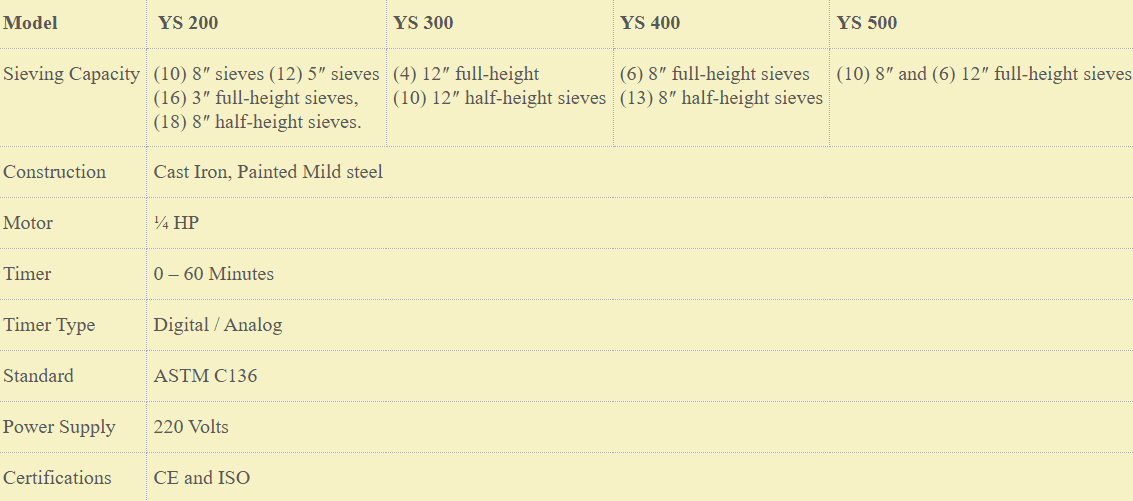
Technical Specifications: Motorized Sieve Shaker
Why Choose a Motorized / Electromagnetic Sieve Shaker?
- We are a trusted provider focused on meeting the needs of professionals involved in laboratory analysis and research. Our range includes practical, reliable equipment solutions supported by safe and timely delivery of analytical and biochemical instruments and accessories for laboratories, medical facilities, educational institutions, and industrial applications.
- High-quality motorized and electromagnetic sieve shakers are offered to ensure maximum customer satisfaction. These instruments help improve safety, accuracy, and efficiency in material analysis. Reach out today to request a quote and enhance your laboratory capabilities.