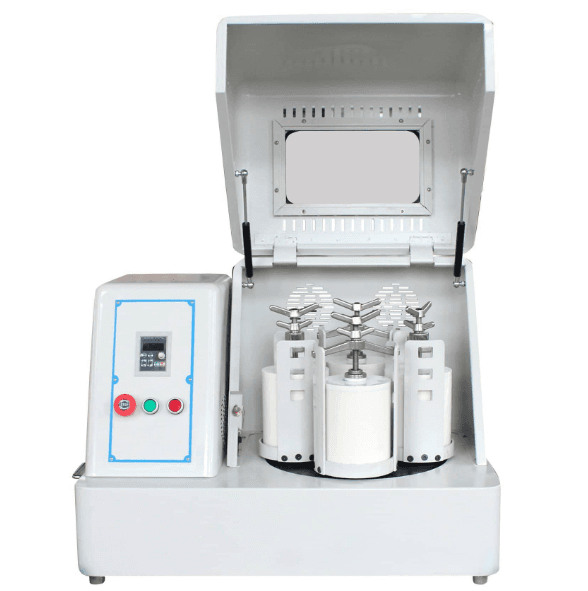
A Planetary Ball Mill is a high-energy grinding system designed for fine grinding, ultra-fine grinding, mixing, homogenizing, and mechanical alloying of a wide range of materials. It is widely used in laboratories, research institutions, and pilot or production environments where high precision and repeatability are essential.
This advanced milling system automates the grinding process, significantly improving productivity while delivering consistent and reproducible results. The equipment is suitable for dry and wet grinding of hard, medium-hard, soft, fibrous, brittle, and moist materials.
Working Principle
- Planetary ball mills operate on the principle of high-energy impact and friction. Grinding jars rotate on their own axes while simultaneously revolving around a central axis, generating extremely high centrifugal forces. These forces cause intense collisions between grinding balls and the sample material, resulting in rapid size reduction to micron and nano ranges.
- Due to the very high energy input, planetary ball mills achieve short grinding times and are capable of producing ultra-fine and nano-scale particles.
Key Advantages
- Suitable for dry and wet grinding
- Capable of nano-grinding and colloidal grinding
- High energy efficiency and fast processing
- Excellent repeatability and uniform particle size distribution
- Safe operation with automatic jar locking mechanism
- Simultaneous grinding of up to four samples
- Ideal for mechanical alloying and homogenization
Technical Aspects of Planetary Ball Mill
- High-energy milling using impact and friction
- Automated grinding with programmable time and speed
- Designed for laboratory research and pilot-scale production
- Robust construction for continuous and intensive use
Features
- Type: Vertical and Horizontal
- Grinding Volume:
- Laboratory use: 2 L to 16 L
- Production use: 20 L to 100 L
- Speed (Fast Grinding): Up to 670 RPM
- Power Supply: 220 V, 50 Hz
- Feed Size:
- Soft / brittle materials ≤ 10 mm
- Hard materials ≤ 3 mm
- Final Particle Size: < 1 µm (material dependent)
- Grinding Time: 1 – 9999 minutes
- Number of Jars: Up to 4 grinding jars
- Grinding Stations: Up to 4 simultaneously
- Sample Types: Hard, soft, fibrous, brittle
- Cooling: Automatic ventilation system
- Safety: High-performance safety interlocking system
Areas of Application
- Planetary Ball Mills are extensively used in:
- Materials science
- Metallurgy and mining
- Ceramics and glass industries
- Pharmaceuticals and biotechnology
- Environmental research
- Chemical engineering
- Nanomaterial research
- Battery and electronic material processing
Typical Application Materials
- Metal oxides, fertilizers, catalysts, coal, limestone, ceramics, cement clinker, glass, pigments, polymers, chemicals, ores, minerals, clay, soil, electronic scrap, fibers, carbon materials, alloys, bones, seeds, plant materials, quartz, paints, varnishes, slag, sludge, and many more.
Optional Accessories
- Multiple jar sizes and materials
- Vacuum grinding jars for inert atmosphere grinding
- Custom grinding ball configurations
- Safety enclosures and dust protection accessories
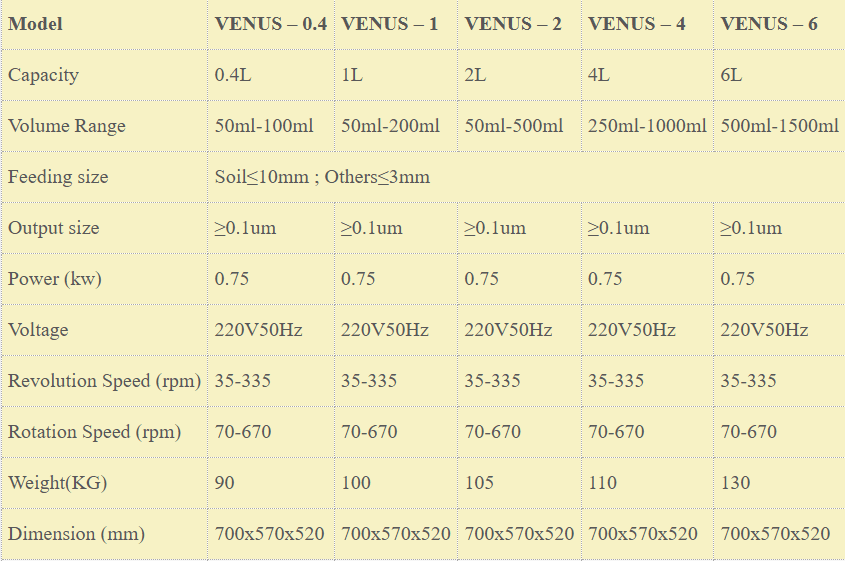
Technical Specifications:
Conclusion
- A Planetary Ball Mill is an essential high-energy grinding solution for laboratories and production facilities requiring fine, ultra-fine, and nano-scale grinding with precision and reliability. Its versatility, safety, and efficiency make it suitable for a wide range of scientific and industrial applications.