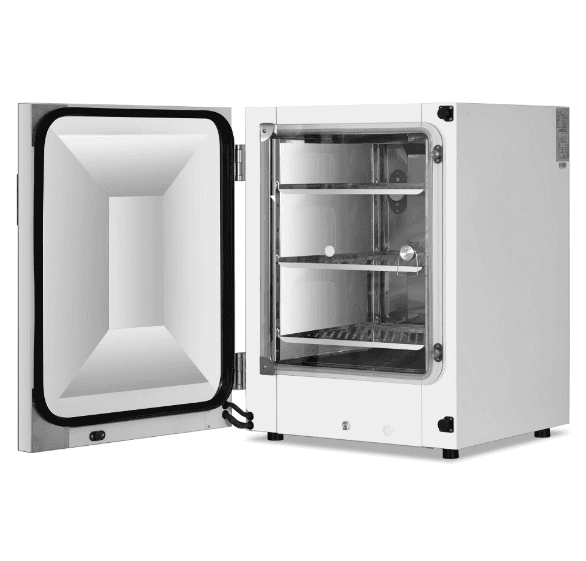
A CO₂ Incubator is a precision-controlled laboratory instrument designed to create and maintain optimal environmental conditions for cell culture and microbiological growth. It provides accurate regulation of temperature, carbon dioxide concentration, and relative humidity, which are essential for maintaining physiological conditions required by sensitive cell lines.
These incubators are widely used in cell biology, microbiology, molecular biology, immunology, genetics, oncology, IVF, and biotechnology laboratories.
What Is a CO₂ Incubator?
- A CO₂ incubator is used to grow and maintain living cells under conditions that closely mimic the human body. By maintaining:
- 37°C temperature
- 5% CO₂ concentration
- ~90% relative humidity
- the incubator ensures optimal pH balance in culture media and supports healthy cell proliferation.
- Air-jacketed CO₂ incubators use direct air heating to ensure fast temperature recovery and excellent uniformity, making them ideal for high-value and contamination-sensitive samples.
Key Advantages of CO₂ Incubators
- Rapid temperature and CO₂ recovery after door openings
- High stability for long-term cell culture experiments
- Reduced risk of contamination
- Uniform growth conditions across all shelves
- Ideal for difficult-to-grow and high-value cultures
Standard Features of the CO₂ Incubator
- Touch-sensitive or digital control panel
- LED digital display for temperature and CO₂ concentration
- High-precision temperature control with excellent uniformity
- Real-time CO₂ concentration monitoring
- Air-jacketed direct heating system
- Internal UV sterilization lamp for chamber decontamination
- HEPA-filtered air inlet to prevent microbial contamination
- Heated inner glass door to prevent condensation
- Stainless steel inner chamber with rounded corners
- Height-adjustable perforated shelves
- Programmable audible and visual alarms
- Safety switch to prevent prolonged inner door opening
- Access port for sensors and sampling
- Optional humidity monitoring sensor
- Remote alarm contact option
Chamber & Safety Design
- Stainless steel interior (SS 304) with smooth, rounded edges for easy cleaning
- Removable inner door trim for thorough disinfection
- Reversible outer door for flexible installation
- Condensation-free viewing window to minimize contamination risk
- Independent over-temperature safety thermostat
Temperature Control Specifications
- Control Range: Ambient +5°C to 60°C
- Set Point: 37°C (default)
- Uniformity: ±0.2°C @ 37°C
- Accuracy: ±0.1°C
- Recovery Rate: ~0.25°C/min (average)
- Display Resolution: 0.1°C
- Sensor Type: Precision integrated circuit
- Display Type: Single or dual display options
CO₂ Control Specifications
- Control Range:
- 0.1–20% (standard)
- Optional ranges: 0.1–5% or 0.1–10%
- Accuracy: ±0.1%
- Recovery: From door opening to 5% ±0.2% within ~5 minutes
- Display Resolution: 0.1%
- Sensor Type: Infrared (single-source, dual-wavelength)
- Control Logic: Fixed algorithm with environmental adaptability
- Operating Gas Pressure: 5–20 PSI
Uses & Applications of CO₂ Incubators
- CO₂ incubators are widely used in:
- Mammalian cell culture
- Stem cell research
- IVF and fertility laboratories
- Tissue engineering and regeneration
- Genomic and proteomic studies
- Cancer and immunology research
- Culture of transgenic and hypersensitive cells
- Pharmaceutical research and drug development
- Microbiology laboratories
- Universities and academic research institutions
- Blood banks and clinical research labs
Why Choose a CO₂ Incubator?
- Maintains physiologically relevant growth conditions
- Ensures reproducibility and experimental accuracy
- Protects sensitive cultures from contamination
- Supports long-term and high-value research
- Essential for advanced biological and medical studies
Conclusion
- A CO₂ Incubator is a critical piece of laboratory equipment for any facility involved in cell culture, biotechnology, pharmaceuticals, IVF, and life-science research. With precise control of temperature, CO₂, and humidity—combined with advanced safety and contamination-prevention features—it ensures reliable, repeatable, and high-quality experimental outcomes.