
Calibrated test sieves are precision laboratory tools used for granulometric (particle size) analysis. These sieves are manufactured using high-quality stainless steel woven screens, ensuring accuracy, durability, and compliance with recognized national and international standards.
Granulometric analysis determines particle size by separating materials into defined size ranges. This separation process is achieved through calibrated mesh openings, allowing reliable classification and control of particulate materials in laboratory and industrial applications.
Each calibrated sieve is supplied with appropriate technical documentation and calibration certification, ensuring traceability and measurement confidence.
Objectives of Granulometric Analysis & Control
- Classify product components based on geometric particle size
- Determine particle size distribution
- Verify and control industrial screening processes
- Maintain consistency in production quality
- These analyses are typically carried out in laboratories using standardized calibrated sieves on representative product samples.
Influence of Material Density on Sample Size
- The specific weight of the material directly affects particle size determination:
- Low-density materials: Sample size should be closer to the lower recommended limit
- High-density materials: Sample size should approach the upper recommended limit
- With repeated testing and operator experience, the optimal screening duration for each material can be accurately established.
Testing Sieves Mesh Chart :
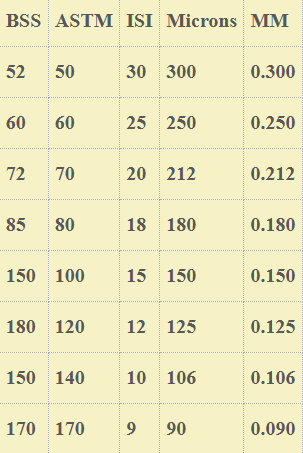
Testing Sieves Mesh Chart :
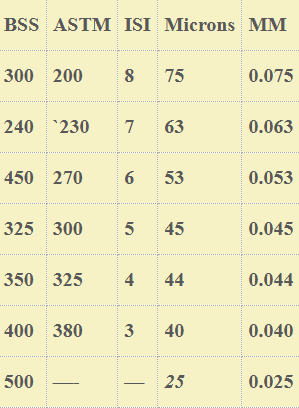
Cleaning Instructions
- Immediately after use, remove residual material using a soft dry cloth or brush
- If necessary, apply compressed air to dislodge particles from the mesh
- For stubborn residues, rinse with running water or use a cloth lightly moistened with an organic solvent (e.g., alcohol or acetone)
- If used in acidic wet sieving, immerse the sieve in a sodium bicarbonate solution for 5 minutes, then rinse thoroughly with water
Handling and Storage Instructions
- Do not expose sieves to temperatures above 70 °C, as this may weaken the rim bonding
- Store sieves in their labeled protective cases
- Avoid environments with moisture, dust, or corrosive vapors
- Clean delicate meshes gently without applying pressure
- Do not remove the identification label or protective film
Application Areas of Calibrated Test Sieves
- Calibrated test sieves are used to separate particles according to predefined mesh sizes in:
- Food processing
- Chemical manufacturing
- Pharmaceutical production
- Construction & building materials
- Mining and mineral processing
- Agriculture and soil testing
- Research laboratories and academic studies
Why Choose These Calibrated Test Sieves?
- Manufactured according to recognized international standards
- Supplied with calibration certification for traceability
- High mechanical strength and long service life
- Suitable for repeated laboratory and industrial use
- Designed for precise, repeatable particle size measurement
- Supported by professional technical guidance and consultancy
- These calibrated test sieves provide a reliable, accurate, and cost-effective solution for laboratories and industries that require dependable granulometric analysis.